
7 Daily Safety Habits for School Bus Drivers
Taking the wheel with dozens of young students behind you carries real responsibility, but it does not need to feel overwhelming. Navigating heavy city traffic or handling heavy rain on local backroads can test anyone’s patience but establishing simple, repeatable safety routines gives you the confidence to handle any challenge with ease.
We’re covering seven safety habits every BC school bus driver should master, how driving environments shift between different parts of the region, and how proper commercial driver training prepares you to handle every trip safely.
What are the top safety rules for school bus drivers in BC?
BC school bus drivers must follow strict provincial safety rules under Ministry of Transportation guidelines, like completing daily pre-trip inspections, executing standardized student loading procedures with flashing red lights, making full stops at all railway crossings, maintaining active mirror checks, adjusting speeds for weather, keeping proper follow distances, and carrying required emergency gear.
Before you start transporting passengers, getting solid instruction makes a massive difference. Enrolling in a recognized Class 2 driver training course gives you hands-on experience behind the wheel, alongside air brake preparation and defensive driving tools to keep every daily journey running smoothly.
7 Daily Safety Habits for School Bus Drivers
1. Thorough Pre-Trip Inspections
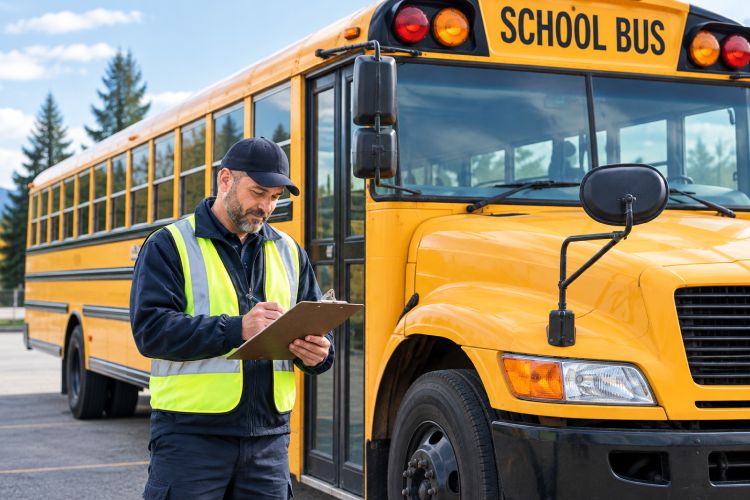
Every morning begins in the yard before the bus ever leaves for its first morning pick-up. Taking time to walk around the vehicle to check tires, glass clarity, and exterior signal lights prevents mechanical surprises later on. Inside the bus, you should also test the emergency exit doors, confirm that seats are secure, and complete a full air brake system check. Verifying air pressure buildup rates and checking for system leaks ensures your braking power is fully reliable before any child climbs aboard.
2. Controlled Student Loading & Unloading
Student pick-up and drop-off zones require total concentration. As you approach a designated stop, turn on the amber warning lights early to warn drivers behind you. Pull over cleanly, set the parking brake, shift into neutral, and activate the red flashing lights and side stop arm if necessary. Drivers should maintain a visual count of students approaching or leaving the vehicle, and should avoid putting the bus into motion until every child is seated inside or safely clear of all blind spots on the sidewalk.
3. Active Mirror Scanning
Large buses have significant blind spots, especially directly in front of the hood, along the right side, and right behind the rear bumper. Developing a systematic mirror scanning routine every five to eight seconds keeps you aware of your surroundings. Alternating your vision between cross-view mirrors, flat side mirrors, and convex mirrors allows you to spot approaching vehicles, cyclists, or young pedestrians who might be walking through a blind spot.
4. Maintaining Space Cushions
Stopping a 40-foot commercial vehicle takes considerably more distance than stopping a standard passenger car. In ideal road conditions, maintain a minimum follow distance of four to six seconds behind the vehicle ahead. When carrying a full load of students, smooth braking prevents passengers from slipping in their seats and leaving a generous space cushion in front of your bumper also gives you a clear line of sight. This also gives you plenty of room to steer around unexpected hazards without sudden evasive maneuvers.
5. Smart Intersection Management
Intersections present frequent hazards for large passenger vehicles. When making turns, approach slowly, check crosswalks for pedestrians twice, and position your bus carefully. Right turns require particular attention so the rear dual-wheels do not climb the curb or sweep across bike lanes. Taking extra room to execute wide turns cleanly protects street infrastructure, keeps pedestrians safe, and keeps the bus damage-free.
6. Adapting to Sudden Weather Changes
Weather conditions across BC can change unexpectedly and vary from city to city. Early morning runs often bring low-lying agricultural fog, heavy autumn downpours, or sudden winter black ice. When visibility drops or pavement turns slick, ease off the accelerator, increase your follow distance to eight seconds or more, and use smooth, gradual steering inputs. Adjust your speed during weather changes to keep the vehicle balanced and under full control.
7. Emergency Readiness
Expecting the unexpected and being prepared keeps minor issues from turning into major problems. Whether managing a sudden student health issue, dealing with an onboard disruption, or pulling over for a mechanical warning light, having a clear plan keeps you calm. Practice securing the vehicle, setting up reflective warning triangles, and using your two-way radio to contact dispatch efficiently while keeping young passengers safe and reassured.
What driving hazards do school bus drivers face in urban areas?
Urban school bus driving involves managing dense commuter traffic, complex multi-lane intersections, frequent stop-and-go conditions, and heavy pedestrian activity. Drivers must monitor tight pickup zones, impatient drivers attempting to pass stop arms, delivery vans, and school zone congestion during peak morning and afternoon hours.
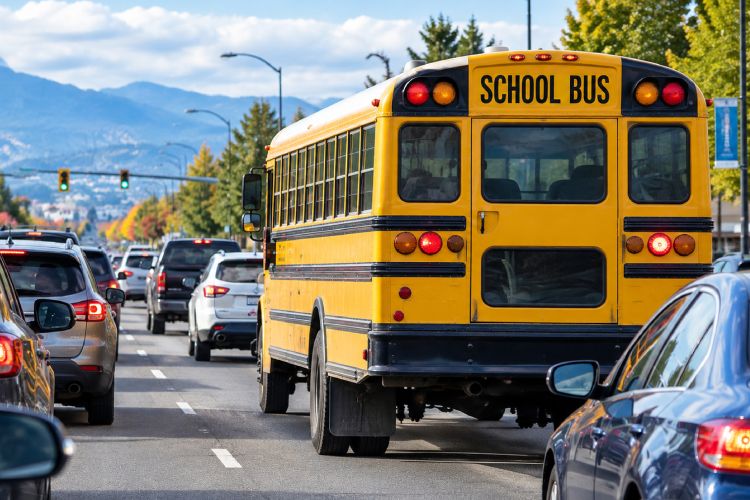
Guiding a full-sized passenger vehicle through busy city environments, like in Burnaby or Surrey, demands forward planning. During morning rush hours, traffic along major thoroughfares gets crowded fast and school bus drivers could face frequent lane merges, crowded turning lanes, and impatient commuters who might attempt risky passes around a stopped bus. Staying focused, signaling your intentions early, and taking space calmly keeps traffic frustration from turning into a safety hazard.
In growing residential neighborhoods, local streets create a distinct set of challenges. Roads are often lined with parked cars, delivery trucks, and parents dropping off students in personal vehicles. Navigating narrow residential loops requires lower speeds and active mirror work. Watching for children stepping out from between parked vehicles or cyclists turning out of driveways requires defensive awareness behind the wheel.
What hazards do school bus drivers face on rural backroads?
Rural school bus drivers face narrow lanes, soft shoulders, deep drainage ditches, unlit agricultural areas, and slow farm machinery. Seasonal weather adds visibility hazards such as thick ground fog, heavy rain, and icy pavement along open backroads and the freeway. Managing these routes requires patient speed control, early positioning, and ongoing scanning.
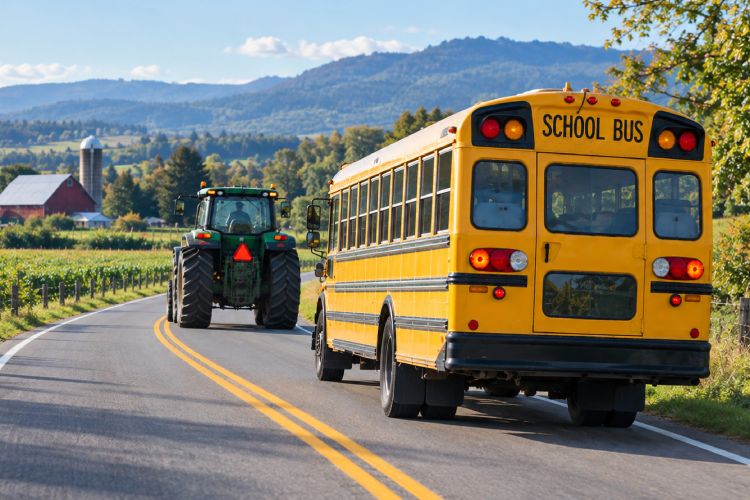
Taking a 40-foot bus off main city streets onto narrow country lanes changes how you handle your vehicle. Driving past berry farms in Abbotsford, backroads often lack paved shoulders and feature deep drainage ditches right along the gravel edge. Getting around big tractors or passing oncoming gravel trucks on these narrow stretches takes patience while managing vehicle control. Slowing down early, holding your line on solid pavement, and waiting for a wider turnout keeps your outer tires from dropping onto soft shoulders.
Weather conditions can shift quickly once you get out into open country. Early morning runs near Aldergrove and Chilliwack frequently bring thick ground fog that sits low over the road, cutting visibility down to a few bus lengths. In the winter, cold air pooling in low-lying spots turns damp asphalt into black ice, especially on river bridges and overpasses along the freeway. Easing off the gas, easing into your brakes, and increasing following distance gives plenty of room to react smoothly no matter what weather rolls in.
Where can you train to become a school bus driver in BC?
You can train to become a school bus driver at accredited commercial driving schools across British Columbia. Professional programs focus on practical in-cab instruction, hands-on pre-trip inspection routines, and ICBC-approved air brake certification. These courses provide the real-world skills needed to safely operate passenger buses on roads and pass your Class 2 road test.
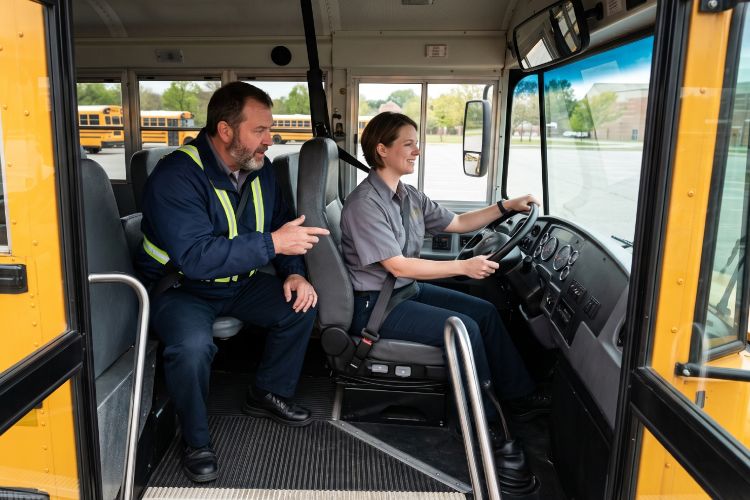
Choosing the right training program comes down to picking a well-established, accredited driving school with a solid track record. Look for a school that offers complete in-class air brake instruction coupled with online practice tools that help you study for your ICBC learner’s test at your own pace. Selecting a provider with multiple locations across nearby communities makes fitting your driving lessons into a busy week much simpler. You should also look for a school that maintains an active job board, connecting you directly with local fleet operators as soon as you finish your license.
If you don’t have the time or budget to take a full Class 2 program right away, earning a Class 4 licence offers a quick and affordable stepping stone. Getting your Class 4 Unrestricted licence allows you to drive community shuttle buses and passenger vans, while a Class 4 Restricted licence lets you operate ride-share vehicles and taxis. This serves as an accessible path to get you working behind the wheel, where you can gain valuable experience and earn income while you plan your next step up to commercial passenger buses.
–
Mastering daily safety habits transforms commercial driving into a predictable, highly rewarding career. Whether managing busy morning traffic or navigating quiet agricultural lanes, taking a structured approach to pre-trips, mirror checks, and speed management ensures students arrive at school safe and sound. With quality instruction and dedicated practice, you can build a successful driving career serving your community.
If you want to explore more about getting started behind the wheel of a school bus, check out our previous posts in this series: How to Get Licensed & Work as a School Bus Driver and Should You Become a School Bus Driver in BC.

Focused on supporting the people behind the wheel and sharing their knowledge. As Valley Driving School's Instructor Supervisor, I support scheduling and the day-to-day needs of our Car Instructors from Burnaby to Hope, and am proud to bring our collective road wisdom online.
Related Articles

Funding Options for the Class 1 MELT Program
Interested in earning your Class 1 licence but worried about MELT tuition? Explore key grants, sponsorships, and flexible payment plans to fund your training.
Finding Work as a School Bus Driver
Looking for job options after passing your class 2 road test? Uncover how to build a flexible, year-round driving career in BC.
How You Can Reduce The Cost Of Truck Driving School
Eager to launch your truck driving career without breaking the bank? Find out how flexible payment options and grants keep training within reach.
